Skip to content

Acting out

Glossary

Auditory Processing

Auditory processing difficulties are conditions to be aware of. They can often present among individuals who have experienced fluctuating hearing loss during childhood due to recurrent episodes of ear disease. The functional difficulties can persist even after the hearing returns to normal after the infection, as inconsistent hearing input has affected the neurological development necessary to process sound effectively. The challenges experienced are often similar to those encountered by individuals with mild hearing loss. Additionally, individuals who are Hard of Hearing as a result of early childhood ear diseases also experience auditory processing difficulties, resulting in compounded functional communication problems.

Gratuitous Concurrence

a common behaviour where people tend to say “yes” to questions, even if they don’t fully understand or agree. It means they acknowledge things without necessarily being sure about them. To communicate effectively, it’s essential to recognise this occurs and adapt our approach to meet the need of the individual person who is Deaf or Hard of Hearing so they can understand what is being communicated to them.

Whitefella

an Aboriginal English word commonly used by First Nations people in Australia to refer to non-Indigenous Australians, typically those of European, often Anglo-Saxon, descent. The use of "whitefella" can be seen as a pragmatic and straightforward descriptor. Over time, as relationships and dynamics evolved, the term has been used in various ways, sometimes neutrally, affectionately, or critically, depending on the context and the speakers' intentions.

Trauma

Is the experience of highly distressing or frightening events that can result in psychological harm, known as trauma. What may constitute a traumatic event can differ between people, so that two people can experience the same event and one can experience trauma and the other does not. Secondary or vicarious trauma refers to trauma experienced by observing harm done to others. The experience of multiple traumatic events can result in complex trauma. Challenges associated with trauma may occur directly after the traumatic event or much later. Some people experience ongoing challenges that impact on their ability to cope or function. With the right supports, many people recover well from traumatic events. Many factors contribute to the higher levels of trauma that may be seen within First Nations communities. These include the impact of colonialism and racism contributing to many life and health inequities, and the ripple effect this can have on communities with closer connections to more people whose lives are cared about are impacted. The communication challenges and outcomes of miscommunication for First Nations who are Deaf or Hard of Hearing can also contribute to their experiences of trauma which in turn impacts on the capacity to communicate.

‘Shame’

fear of embarrassment is especially pronounced in collective cultures, such as First Nations cultures, where one's reputation and how others view them holds significant importance. The potential for public failure can be a reason to not engage in certain activities, as the risk of embarrassment (being shamed) is high. This concern is more likely to be felt by people who are Deaf or Hard of Hearing and is a reason why they may avoid participation in situations where the possibility of misunderstanding conversations creates a high risk of being shamed in front of others. When a person refers to ‘shame’ or ‘shame job’ as a reason not do something it is important to try to structure the engagement to reduce the risk of them being shamed.

Poison relationships

In many First Nations cultures, the practice of "poison cousins" involves avoiding direct communication with certain relatives to maintain social boundaries and respect. This tradition helps prevent conflicts and uphold modesty within communities, reflecting a deep commitment to community harmony and structured social relationships. It's a culturally significant way to ensure that family interactions are respectful and appropriate, supporting both community cohesion and individual dignity.

Humbugging

when someone asks for too much or makes unreasonable demands for money, drink, cigarettes, food, household items, cars etc from their family or community. It’s different from the positive practice of sharing resources within Aboriginal and Torres Strait Islander cultures. Instead, humbugging can lead to stress, arguments, and even abuse. This situation (being humbugged) can be particularly difficult for First Nations people with disabilities, who, often have a strong desire to fulfill their cultural responsibilities like other community members, find it hard to know how to refuse such demands.

Hand talk

Many communities have a sign language or hand talk (sometimes called action) that compliments their local spoken language. In these communities many in the community may be able to use sign language to communicate with deaf community members. However, as with oral languages these are diminishing and often Deaf community members can only communicate with a few family members using family hand sign with elements of community sign.

Countryman

"Countryman" is an inclusive term used by some First Nations people to indicate their deep connection and responsibility to their land. It underscores a unique relationship that sets them apart from non-First Nations people, who may not share the same sense of belonging, affinity, or duty to the Country. This term highlights the profound bond First Nations people have with their land, which is central to their identity and cultural responsibilities.

Behaviours of concern

Behaviours of concern are actions displayed by individuals that might be disruptive, harmful, or challenging to themselves or others. These behaviours often occur when someone is unable to communicate their needs, feelings, or frustrations in more typical ways. They might include yelling, hitting, or refusing to follow rules or instructions. The goal in addressing these behaviours is to understand what the individual is trying to communicate through their actions and to find more positive and effective ways for them to express their needs and desires.

People that are more reliant on others in having their needs met, may be more likely to ‘act out’ as a way of communicating or putting pressure on others to have their needs met. This may especially be the case for people with significant hearing loss and co-occurring or multiple disabilities and communication difficulties.

When participants who are Deaf or Hard of Hearing ‘act out’, they are often confused and frustrated at things not being explained in a way that they can understand. This can be in the form of being told “tell you later”, “ go away it’s not to do with you” or “this is woman’s business”.

This frustration and confusion of what others can hear and they can not can cause a heightened sense of rejection and abandonment. The sense of exclusion can trigger a response that may cause conflict and violence because they have been so upset about being excluded in the past. Trauma has resulted from repeated rejection from others, so it now triggers ‘acting out’ if they again feel ignored or rejected.

‘Acting out’ may look different for different people. It may look like an escalation in both physical and verbal expressions of distress, frustration and anger (e.g. yelling, pacing, threatening, invading others personal space, aggressive behaviours), defiant actions, or it may involve the destruction of property.

Some forms of acting out are actually quite clever, but with extraordinarily difficult consequences as highlighted in the case study below.

Case study

Not ready to leave

David was moved into a group home shortly after receiving his NDIS plan. His plan also involved supporting to make trips back home. On one such visit, David went with two support workers to visit family and community. After a few hours, David noticed the support workers talking and assumed they were going to take him back to the group home. David wasn’t ready to leave. He started damaging the support workers car so that they couldn’t leave. His frustration grew and the workers were not able to calm him down. David finally sat down when he saw the police arrive. The police took him back to the group home.
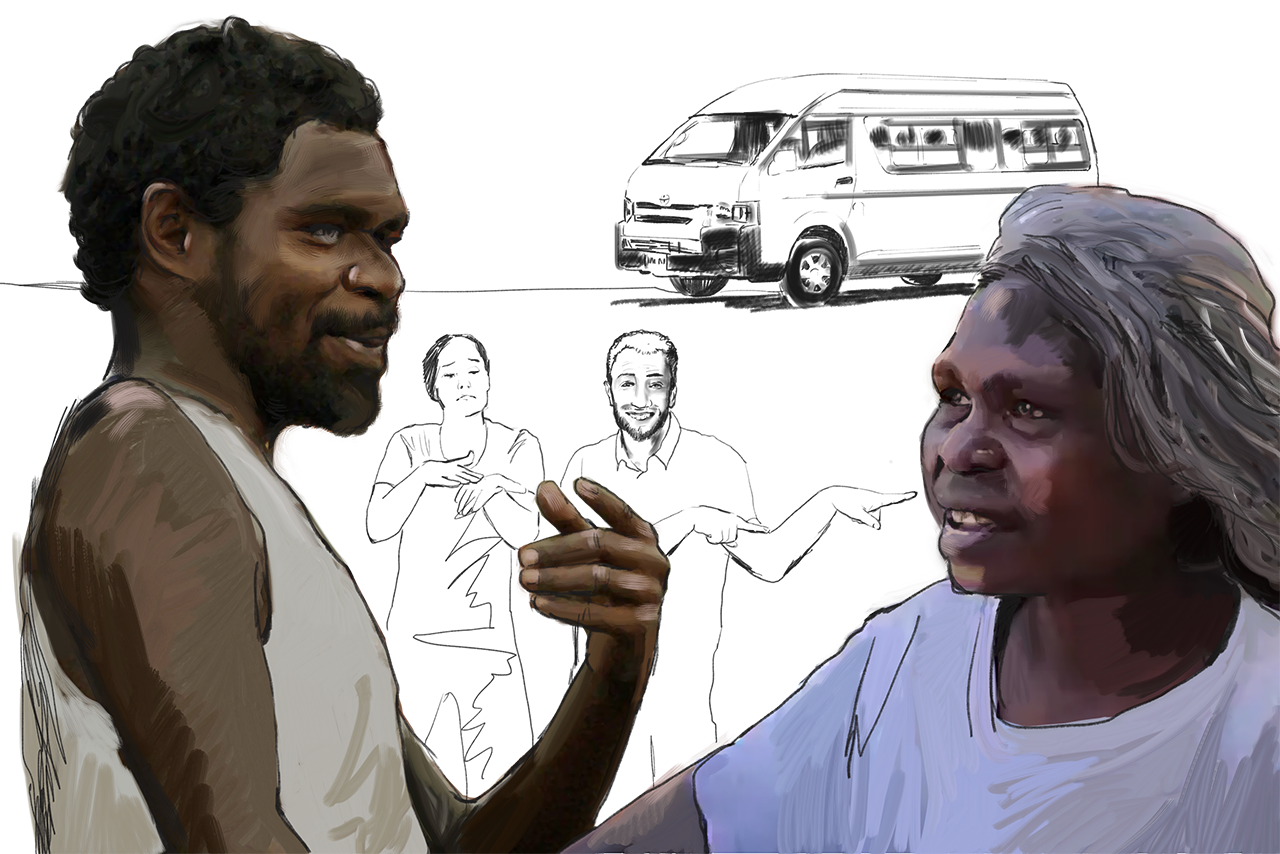
The next week David wouldn’t talk to the workers or get in the car to go out. A cultural and communication broker was engaged to try and resolve the issue. It turns out David had misinterpreted the workers conversation and that they had intended to pick him up the next day as planned. Despite clarifying the issue, David had lost trust in the workers and was deemed too high risk to take out on Country. While family continued to visit, David didn’t go home or attend ceremony for a long time. He became increasingly dis-engaged in life.

At a follow-up meeting with the broker, the group home realised that despite their best efforts, David was not going to regain his trust in the workers. A new worker was therefore found and strategies put in place to build trust and communication with David. The support relationship is going well and they are slowly planning to visit Country later in the year.

Broadcasting 

What is seen as ‘acting out’ may also be a form of culturally tolerated communication whereby expressing dissatisfaction loudly and verbally is an accepted way to express concern and have one’s needs met. This kind of public behaviour can be seen as threatening and alarming to those who do not understand that people are using an accepted cultural form to register dissatisfaction.

“Aboriginal culture, with its greater focus on collective rather than individual responsibility, tends to favour communication styles that promote group discussion and consensus building. ‘Broadcasting’ is one of these (Walsh 1997). People comment on a subject in a public space, and other people can choose to respond or remain silent. ‘Broadcasting’ can be used to raise concerns about an issue in a gathering where collective discussion and decision-making can take place. Someone else may ‘broadcast’ similar concerns, or amplify what has already been said. ‘Broadcasting’ can be used to apply social pressure, by bringing the acts of individuals to the attention of others (shaming), although these individuals are often not mentioned by name.

– Mixed Messages p46

References

Mixed Messages p46 – https://zenodo.org/record/3826158 

Once you are happy that you have understood this Topic - please select "Mark Complete" above.
To complete the Bina Gurri Yarns Course you must "Complete" all Topics.

Secret Link